Industrial coating for electronic enclosures: powder or liquid?
Industrial coating is a production phase that directly affects the quality, resistance and durability of electronic enclosures. It is not just about adding color to the finished product, but about applying a coating capable of protecting the metal structure from external agents, improving its functional performance and, when required, ensuring consistency with the device design.
In the field of mechanics for electronics, the choice of coating process has direct implications on corrosion resistance, contact conductivity, thermal dissipation and IP protection rating. For this reason, identifying the most suitable solution for your project is a technical decision, not an aesthetic one.
The two most widely used technologies in electronic enclosures are powder coating and liquid coating. Both offer specific advantages and are suited to different needs. In this guide, elmec analyzes them in detail to help you make the best choice for your application.
Powder coating: process, materials and applications
Powder coating is a finishing process based on the electrostatic application of thermosetting powder coatings onto a metal surface. The principle is simple: the component is positively charged and the powder negatively charged, ensuring uniform adhesion across the entire surface before the curing phase in the oven.
The most commonly used resins are epoxy, polyester, hybrid (epoxy-polyester) and acrylic. Each type offers different characteristics in terms of UV resistance, elasticity, aesthetic finish and chemical protection. The choice of resin must be tailored to the operating conditions of the final product: indoor, outdoor, industrial or corrosive environments.
After application, the parts enter curing ovens at temperatures between 180 and 200 °C, required for full polymerization. Achievable coating thickness typically ranges between 60 and 100 microns, ensuring a robust and long-lasting protective barrier against impacts, abrasion and weathering.
Advantages of powder coating
High mechanical and chemical resistance: the cured film resists scratches, impacts and corrosive agents, making it ideal for enclosures used in industrial or outdoor environments.
Solvent-free process: no volatile organic compounds (VOCs) are used, resulting in a significantly lower environmental impact compared to liquid coating.
Powder recovery and recycling: non-adhering particles are collected, recycled and reintroduced into the production cycle, reducing material waste.
Uniform finish without runs: the nature of the process almost completely eliminates defects such as bubbles or drips.
Limitations to consider
Electrostatic charges may concentrate on edges and corners, making it more difficult to achieve uniform thickness on highly complex geometries.
Setup costs and start-up times are higher than for liquid coating, with minimum powder purchase quantities (typically 25–50 kg).
Creating uncoated conductive areas (selective masking) requires adhesive tapes resistant to high curing temperatures, increasing operational complexity.
For these reasons, powder coating is particularly suitable for medium and large production runs and applications where mechanical and environmental resistance is a priority.
Liquid coating: flexibility and application precision
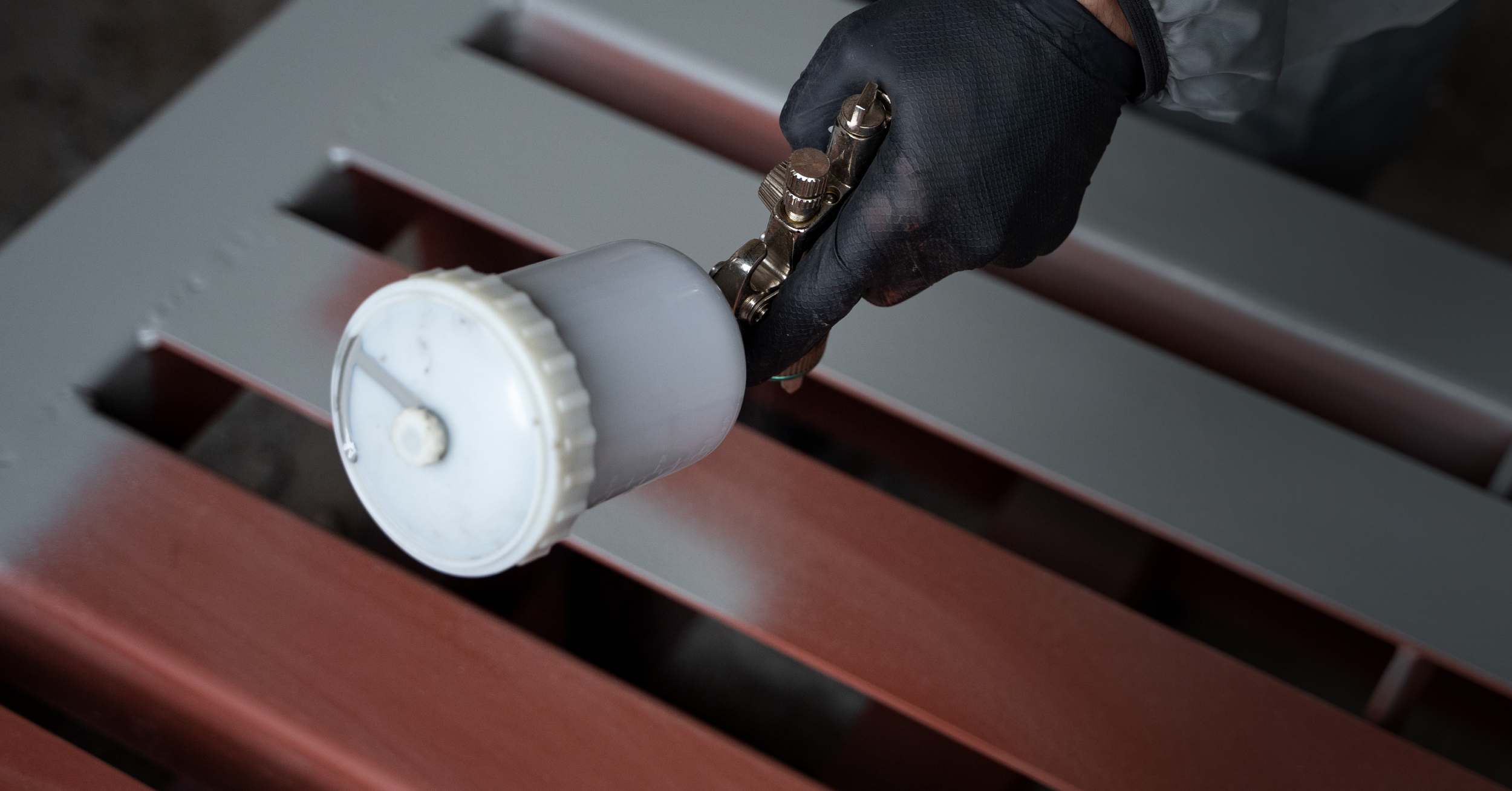
Liquid coating involves the manual spraying of liquid paint onto the component surface, typically using compressed air guns or electrostatic systems. Application techniques include high-pressure spraying, mixed spraying and electrostatic spraying, selected based on the desired result and part geometry.
Unlike powder coating, curing temperatures are moderate, typically between 60 and 80 °C. This allows treatment not only of metals but also non-conductive materials such as plastics, expanding application possibilities in the electronics sector.
Advantages of liquid coating
Uniform coverage on complex geometries: manual application allows reaching corners, undercuts and difficult surfaces with consistent thickness distribution.
Selective masking for electrical contacts: it is possible to leave metal areas uncoated simply by directing the spray or applying light masking, ensuring conductivity where required.
Low setup costs: no minimum paint quantities are required and equipment preparation is fast, making the process ideal for small and medium batches and prototyping.
Wide range of colors and finishes: RAL shades, pearlescent effects, soft-touch finishes, chrome-like coatings and special finishes are easily achievable, offering maximum aesthetic customization.
Limitations to consider
If application is not properly controlled, defects such as bubbles, runs or uneven thickness may occur.
Many liquid coatings contain organic solvents, resulting in higher environmental impact and the need for proper emission control systems.
Powder vs liquid coating: direct comparison
The choice between powder and liquid coating depends on project specifications. Here is how the two technologies compare across the most relevant parameters for electronic enclosures.
From an application standpoint, powder coating relies on an electrostatic mechanism and is often automated, while liquid coating can be applied manually or through automated systems, including electrostatic ones. This difference directly affects setup costs and times: higher for powder (which may involve logistical constraints and minimum quantities related to powder management), lower and faster for liquid, which does not require minimum quantities.
Curing temperatures represent another key difference: powder coating requires ovens at 180–200 °C for polymerization, which limits its use mainly to metallic substrates or materials resistant to such temperatures. Liquid coating operates at lower temperatures (60–80 °C) and can also be applied to non-conductive materials such as plastics. Powder coating thickness typically ranges between 60 and 120 microns, offering a generally stronger protective barrier compared to liquid coatings.
In terms of complex geometries, liquid coating excels: manual application allows reaching corners, undercuts and cavities with uniform distribution. Powder coating, on the other hand, may encounter difficulties in deep cavities and undercuts due to the Faraday cage effect. The same applies to selective masking required to preserve conductive areas for electrical contacts: with liquid coating, it is sufficient to direct the spray or apply light masking, whereas powder coating requires high-temperature resistant tapes.
From an environmental perspective, powder coating has a clear advantage: it does not use VOCs and non-adhering particles can be recovered and recycled. Liquid coatings, on the other hand, often contain solvents that require appropriate abatement systems.
In terms of aesthetics, both technologies offer a wide range of RAL colors. Liquid coating stands out for special effects (pearlescent, soft-touch, chrome-like), while powder coating ensures a highly uniform finish, virtually free from runs. The mechanical resistance of powder-coated films is generally higher in standard cycles, making it the preferred choice for demanding industrial environments or outdoor installations.
In summary, powder coating is ideal for medium and large production runs on metal components intended for harsh environments, while liquid coating is the most flexible solution for small and medium batches, prototyping, complex geometries and applications requiring selective masking for conductivity.
Focus: coating aluminum in electronic enclosures
Aluminum is one of the most widely used materials in the production of electronic enclosures due to its light weight, thermal conductivity and workability. However, it is also particularly challenging to coat properly: without adequate preparation, the coating may not adhere correctly and may degrade over time.
Powder coating is one of the most effective treatments for aluminum: it protects against corrosion, increases resistance to chemical agents and ensures long-lasting finishes. To achieve excellent results, it is essential that the part has undergone proper pre-treatment (pre-cleaning and chromate conversion) and is free from burrs or processing residues.
How to choose the right coating for your electronic project
There is no single answer to the question “powder or liquid coating?”. The choice depends on several project-specific variables. Here are the main decision criteria:
Production volume: for small batches and prototyping, liquid coating offers greater flexibility and lower start-up costs. For medium and large series, powder coating becomes more efficient and competitive.
Base material: if the enclosure is metal (steel, aluminum, stainless steel), both solutions are viable. For plastic or non-conductive components, liquid coating is the only option.
Required IP rating: coating contributes to enclosure durability. Evaluating thickness and resistance is essential to support the required IP rating.
Installation environment: outdoor, corrosive or high-humidity environments require more robust coatings. In these cases, powder coating—possibly combined with specific surface treatments—offers greater reliability.
Conductivity requirements: if the project requires exposed metal areas for electrical contacts or grounding, liquid coating significantly simplifies selective masking.
Part geometry: components with complex shapes, undercuts or deep cavities are better suited to liquid coating, which ensures more uniform thickness distribution.
Industrial coating with elmec: one partner, full expertise
At elmec, coating is an integral part of our production ecosystem. We do not simply apply a finish, but integrate surface treatment into the design and manufacturing process of the enclosure, evaluating from the earliest stages which solution will ensure the best result.
We manage core processes in-house (laser cutting, CNC bending, punching, CNC milling) and rely on a consolidated network of specialized technical partners for additional processes, including coating, surface treatments and special finishes.
This allows us to operate as a single point of contact for the entire production cycle: from material selection to final finishing, every phase is coordinated, monitored and verified to ensure maximum quality consistency. We also offer a range of supply services, from prototyping to electronics integration, up to lean production management.
Whether you need a custom enclosure or want to choose from our standard products, we can help you identify the most suitable coating for your project, application context and required volumes.
Want to understand which coating is right for your electronic enclosure? Contact us for a technical consultation: we will analyze your project together and find the solution that protects and enhances your electronics.